
Adam Dalgliesh is involved with our local sustainability groups and has kindly provided this case study to share his approach and experience. Contrary to what people may tell you at the pub (or anywhere else for that matter) it is totally possible to heat older buildings with heat pumps.
The House
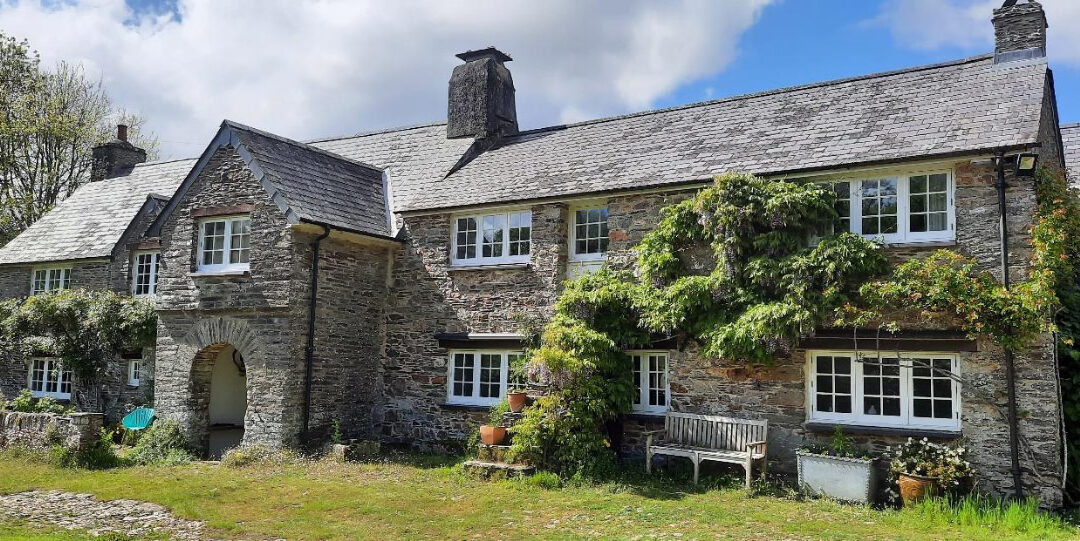
We live in a wonderful, old, Grade II listed farmhouse. I grew up here and so when the chance arose to move back in with my growing family, we jumped at it. My parents brought it back from dereliction in the early 1970’s and made it into a very happy home. It had thick stone walls, a slate roof, single glazed timber windows, mains gas central heating, and 3 phase electricity. It was only ever properly warm when the central heating was on, and/or the fire was lit. My wife doesn’t do well in the cold, so we had to find a way to bring up the temperature of the house (without running the gas boiler 24/7) thus increasing its thermal efficiency and bring it into the 21st Century.
The Issues
The key mantra was one of reducing heat loss, before we looked at heat generation. Apart from being sensible, it was also a pre-requisite of attaining the domestic Renewable Heat Incentive (RHI) grant. The Energy Performance Certificate (EPC) of the house was F before we started.
Loft – the loft space was insulated at rafter level with 1970s insulation board and around 100mm of glass fibre wool between the joists. We left the rafter insulation in situ and increased the floor insulation to 300mm.
External doors and windows – all single glazed areas were replaced with double glazing. In
the older, listed, parts of the house we had to discuss with the Conservation Officer to get
approval.
First floor void – this had poor insulation levels. It has become a services sandwich containing
heating pipes for the ground floor radiators, all plumbing runs, most of the electrics, data
cabling, and the underfloor heating for the first floor. The insulation level was also significantly
increased.
Lighting – all lighting was changed from incandescent bulbs to LED.
Following completion and reinspection the house achieved an EPC of C (77) only 4 points off a B, which makes it more thermally efficient than most new builds.

The Heating System
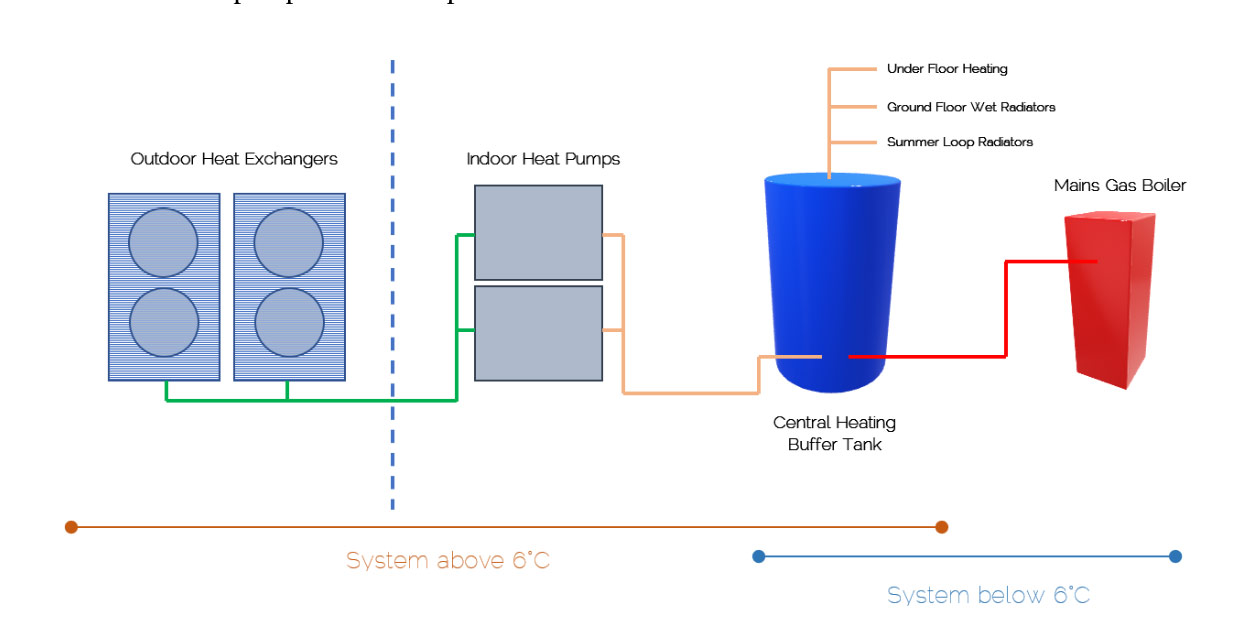
This is a hybrid system using both high temperature heat pumps and the mains gas boiler. If the outside temperature drops below 6 ̊C then we switch from the heat pumps to the gas boiler to provide heat for the heating system. This is for economic reasons as the costs of running heat pumps increase as the temperature drops, and gas is cheaper per kWh than electricity. The demand load on a big old house is also significant which affects the performance.
The Coefficient of Performance (COP) for a heat pump is around 4.0. This means for every kW of power you put in; you get 4 kW of heat out. For comparison a gas boiler has a COP of around 0.95. However, as the ambient temperature falls the heat pump COP falls so that at 0 ̊C it is around 2.5. Thus, to generate 1 kW of heat from the heat pumps in normal temperatures takes around 0.25 kWh, or 7.1p at today’s prices (who knows what it will be tomorrow! *) and using gas takes around 1.05 kWh of gas or 7.9p. At freezing the gas is the same but the heat pumps cost to generate 1 kW of heat rises to 11.4p.
*(Adam wrote this a while ago, before the energy crisis, and you can see that he was right to say that he didn't know what the prices would be tomorrow.)
Irrespective of cost, we must not lose sight of the positive environmental impact which is why most of us move to heat pumps in the first place!
The Costs
As with any transition to greener methods of heating there is always a question of cost and how long it will take to pay off any capital expenditure. I take the view that sooner or later we will all have to move away from fossil fuels so better to move when you can (i.e., your boiler needs replacing, or you have the requisite capital).
The various grants that have now disappeared (Renewable Heat Incentive (RHI) and Feed in Tariff (FiT)) have, for the main part, done their job, which was to reduce the overall unit
cost through increased demand, and there is now a scheme called the Boiler Upgrade Scheme which offers a £5000 payment towards a heat pump or biomass boiler.
Many people like to use a basic calculation based on the overall cost of installation divided by the heating energy savings per year, to give the number of years to break even. I think this misses a number of crucial criteria:
1. Carbon footprint: you will massively reduce your carbon footprint by replacing a gas/oil boiler with a heat pump.
2. Good quality heat pumps should last 20 years. There is a likelihood that you would need to
replace your fossil fuel boiler once, if not twice during the same period.
3. Heat pumps are very simple and have low maintenance costs compared to boilers.
4. You can self-generate electricity to run your heat pumps (PV arrays) – good luck providing
your own fuel for a gas/oil boiler!
5. It will improve the value of your home. OK, so this has yet to be quantified, but some estimate a house with heat pumps, a solar array and batteries will be worth up to 5% more than one without.
I am very happy to show people around the system if they are interested in heat pumps and feel this could be a good solution for their own home.
Adam Dalgliesh
Our thanks to Adam for this in depth look at his low CO2 heating system. If you'd like to ask Adam any questions, or would like to contact him to take a look at his system, then please just email coordinator@sustainabledittisham.org