
John’s Good News Roundup
Biden’s Clean Sweep
The thing that brought me most joy recently was seeing Joe Biden sworn in as President of the United States and immediately sign 17 executive orders to start undoing some of the damage done by Trump. They included immediately rejoining the Paris Climate Accord, halting drilling in the Arctic National Wildlife Refuge and terminating permits for the Keystone XL pipeline (which would have carried 830,000 barrels of crude oil a day from Canada into the USA). He also instructed federal agencies to begin reviewing and reinstating over 125 environmental regulations that were rolled back by Trump.
Is the Dragon turning Green
As America gets back on the road to combating climate change, China has been forging ahead, more than doubling its construction of clean energy in 2020. In just one year it has added 72GW of wind power, 48.2GW of solar and 13.2GW of hydro, outstripping every other country. China also passed a landmark environmental law protecting the Yangtze, one of the country’s two ‘mother rivers.’ From the 1st of March, chemical projects near the river will be banned and relocated, sand mining will be restricted, and all fishing, including in tributaries, lakes and the estuary, will be forbidden. That is a country at last getting serious about protecting its environment.
Holding back the desert
Development banks and states have just pledged over $14 billion towards planting the Great Green Wall to contain desertification in North Africa. The project covers a strip of land stretching 5,000 miles from the Atlantic Ocean to the Red Sea and is designed to stop the Sahara Desert creeping southwards. Millions of trees and miles of grassland will be planted, and projects launched to create sustainable ecosystems. The aim is to restore over a 100 million hectares and in the process capture 250 million tonnes of carbon.
More Moor Trees
And on a smaller scale, but coming much closer to home, Moor Trees, which grows thousands of trees every year at their Totnes nursery for woodland planting and restoration schemes, has been awarded a grant of nearly half a million pounds from the Government’s £80 million Green Recovery Challenge Fund. It will receive the funding as part of the Close the Gap project, which is designed to achieve bigger, healthier and better-connected hedgerows to enhance bio-diversity and protect wildlife.
Tree planting in Dittisham
Even closer to home, we’ll be planting the first tranche of trees in Dittisham tomorrow in our drive to improve council owned land as wildlife habitat. Sadly Covid restrictions prevent us inviting everyone to come along and help.
Blanket Bogs
Managing moorland is a hot topic at the moment, as re-wilding ideas start to change the way we view our moors, so it was great to see new measures come in in Scotland to license moorland management. DEFRA has now started moving in that direction as well and is bringing in significant reform to moorland burning practices over a very wide area of upland England from Yorkshire to Lancashire and from Derbyshire to Northumberland. It will prevent the burning of heather and other vegetation on protected blanket bog habitats. Burning vegetation on blanket bog is damaging to peatland formation and makes it impossible to restore those habitats to their natural state.
If you need permission for a beaver why not for the release of millions of asian birds?
On a similar theme, the Welsh government are planning to introduce restrictions on game bird releases next year and, after a successful legal challenge from Wild Justice, DEFRA will issue a consultation in early February on that same topic. Perhaps the days of the uncontrolled release of 48 million Asian birds into our countryside every year, there to compete with our native wildlife, are numbered?
Will the Badger Cull stop?
The government has just announced that no new mass culls of badgers will be allowed after 2022. Their plan to eradicate bovine TB (bTB) will instead focus on vaccinating both badgers and cattle and tightening up on the movement of cattle. The whole project was based on very dubious science from the start, with a strong argument that forcing badgers to travel further to find a mate could simply increase the spread. The government’s record on badger culling has been pretty appalling so let’s hope that they stick to their word.
Tiny Terns Return
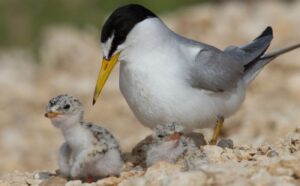
And we often seem to end with a tiny animal and this time it is an American bird, the Interior Least Tern, who weighs in at just two ounces. The demand for its feathers for ladies hats, followed by the loss of large parts of its habitat, dropped its numbers down to just 2,000 but, after 30 years of hard work by conservationists, its population is back up to over 18,000 birds. So there’s another bird off the endangered list! The picture above is of one of the latest generation and its proud mum.
Have a good weekend everyone, spring is on the way!
Cheers,
John
John Nightingale coordinates our Habitat subgroup. To find out about meetings, talks, activities, and news like this just Contact us to join our mailing list. 🙂